
This page is part of our report on The Carter Center.
Published: 2009
Table of Contents
What do they do?
The program aims to eradicate guinea worm, a disease transmitted by contaminated water and associated with pain and temporary debilitation (more on guinea worm).
The Carter Center's program includes:
- The Carter Center provides people with water filtering equipment and increases access to clean sources of water to prevent the spread of guinea worm through drinking water.1
- The Carter Center and the U.S. Center for Disease Control and Prevention (CDC) facilitate heavy monitoring of cases to track progress towards eradication.2
Evidence of effectiveness
General evidence on this program type
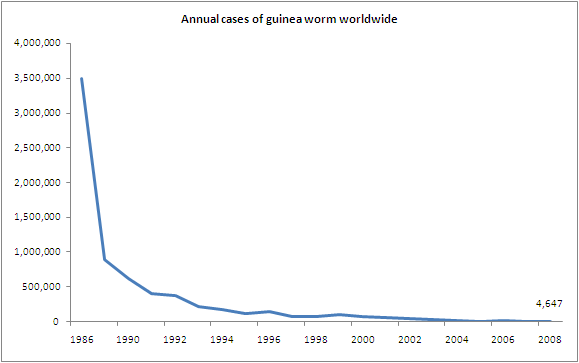
The global effort to eradicate guinea worm is considered a major success story in global health, and the Carter Center is credited with a leading role.3 However, the case for future activity in this area is debatable. For more, see our report on guinea worm eradication, and our discussion of eradication programs.
Data provided by The Carter Center
The Carter Center has led the fight to eradicate guinea worm since the mid-1980s, and provides extremely detailed, monthly reports of guinea worm's current prevalence.4
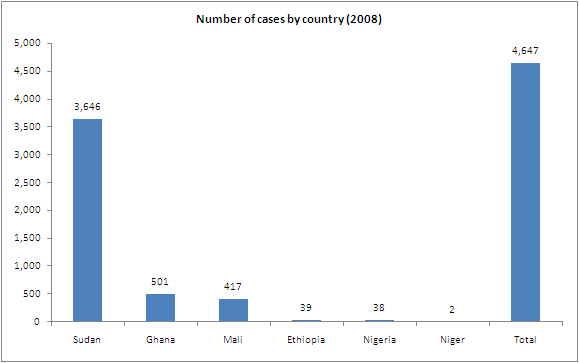
The following charts, reproduced from charts available on the Carter Center's website, show the progress and current status of guinea worm eradication.5
What do you get for your dollar?
Eradication efforts are currently ongoing, and given that success is not assured, it's difficult to estimate cost-effectiveness for the effort as a whole. We estimate that the campaign to date has cost $4-$8.50 per serious case of guinea worm averted, a very strong result (more). However, going forward, the cost-effectiveness situation could be very different, as stated in our discussion of eradication programs.
Sources
- Carter Center. Distribution by country of 4,619 cases of indigenous cases of dracunculiasis reported during 2008 (PDF).
- Carter Center. Number of Reported Cases of Guinea Worm Disease by Year, 1989–2007 (PDF).
- Carter Center. Organization website:
- Guinea worm eradication program. http://cartercenter.org/health/guinea_worm/index.html (accessed April 19, 2010). Archived by WebCite® at http://www.webcitation.org/5p6nUxcAX.
- Guinea Worm Wrap Up. http://cartercenter.org/news/publications/health/guinea_worm_wrapup_eng… (accessed April 19, 2010). Archived by WebCite® at http://www.webcitation.org/5p6m65cL4.
- Levine, Ruth. 2007. Case 11: Reducing Guinea Worm in Asia and Sub-Saharan Africa (PDF). In Millions saved: Proven successes in global health. Washington, DC: Center for Global Development.
- 1
"The Carter Center provides families with fine-mesh filter cloths that fit over clay pots used to hold water. Some people, especially nomadic groups, receive pipe filters, which are small straw-like personal filters that can be worn around the neck...Other important interventions include treating ponds with a safe chemical larvicide called ABATE©, donated by BASF Corporation, and constructing boreholes or deep wells." Carter Center, "Guinea Worm Eradication Program."
- 2
Monthly updates are available on the Carter Center website. Carter Center, "Guinea Worm Wrap Up."
- 3
"The eradication efforts have led to a 99.7 percent drop in guinea worm prevalence. in 2005, fewer than 11,000 cases were reported, compared with an estimated 3.5 million infected people in 1986...A major turning point in the campaign occurred later in 1986 when US President Jimmy Carter began his nearly 20-year involvement in the campaign and became a powerful advocate for eradication, with the Carter Center taking the role of lead nongovernmental organization providing financial and technical assistance to national eradication programs." Levine 2007, Case 11, Pgs 1-4.
- 4
Carter Center, "Guinea Worm Wrap Up."
- 5
- Carter Center, "Number of Reported Cases of Guinea Worm Disease by Year, 1989–2007."
- Carter Center, "Distribution by country of 4,619 cases of indigenous cases of dracunculiasis reported during 2008."